Our Lost Declaration: America's Fight Against Tyranny From King George to the Deep State by Mike Lee
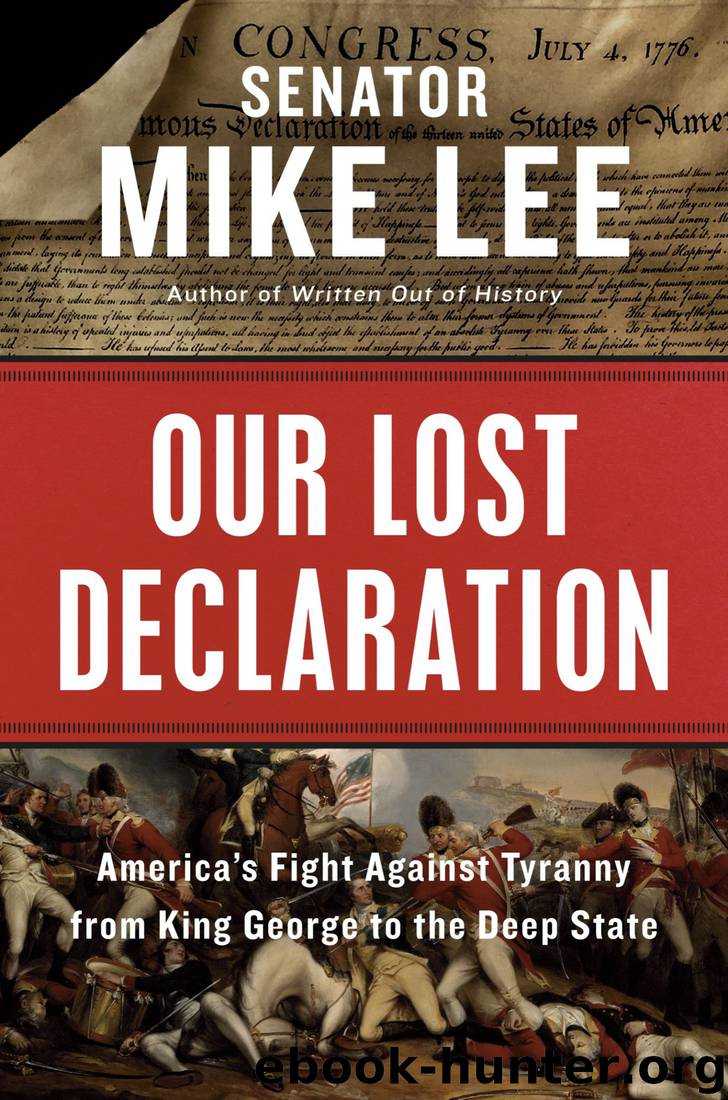
Author:Mike Lee
Language: eng
Format: epub
Tags: 18th Century, History, Political Science, Politics & Government, Revolutionary Period (1775-1800), United States
Publisher: Sentinel
Published: 2019-04-15T03:00:00+00:00
PHILADELPHIA
April 23, 1775
News had just reached Philadelphia that British troops and colonial militias had exchanged fire at Lexington and Concord, a several days’ ride away. The skirmish left men on both sides dead. Paine was outraged. There was no doubt about his loyalties. “When the country, into which I had just set my foot, was set on fire about my ears, it was time to stir. It was time for every man to stir,” he wrote.4 “Those who had been long settled had something to defend; those who had just come had something to pursue; and the call and the concern was equal and universal,” he added.5 Paine felt as one with his fellow Americans pushing for open rebellion.
Even with blood now shed, the idea of independence was still a taboo. If there was going to be a movement for independence or a war, it was more likely that it would be between the colonies than on behalf of all of them. The colonies had very little in common and represented a patchwork of classes, cultures, faiths, and traditions. They squabbled constantly. That the thirteen colonial governments could somehow put aside their differences and organize an independence movement when they hadn’t ever done so was unlikely at best.
Still, a few brave voices pushed the boundaries of what was deemed acceptable political speech. John Adams, a representative of the Massachusetts militiamen killed at Lexington and Concord, moved to have every colony create its own local government and pushed for independence at the newly created Second Continental Congress. It was a radical position, one that made him “an object of nearly universal scorn and detestation,” his friend and fellow representative Benjamin Rush recalled.6 The Massachusetts governor was offering bounties of five hundred pounds (well over one hundred thousand dollars today) for the heads of rebels John Hancock and Samuel Adams.
Paine had better things to do than become an enemy of the Crown. After all, he had a fledgling magazine to tend. In the three months since its launch, the magazine had thrived. Eschewing controversial essays on politics and religion, Pennsylvania Magazine kept things light and optimistic. With new-invention announcements, mathematical puzzles, and images of maidens and flowers, the magazine was quintessentially American in its quirkiness, diversity, and idealism.
But beneath the sunny facade, Paine’s magazine and adopted city kept a lid on a simmering rage. A pacifist Quaker though he was, Paine was breathing in the combustible air around him. British rule was becoming ever more insufferable. Throughout the 1760s, the Crown had increased its punitive taxes and duties with legislation such as the Stamp Act, the Sugar Act, and the taxes on tea. The King was sanctioning increasingly indefensible actions by British troops stationed in the colonies.
Worse still, and especially grating for Paine, was the undeniable attitude of superiority that British officials in the colonies took toward their citizens. They talked and walked among them as if they were “betters” over a crude mob of brutish American ruffians. There was nothing Paine
Download
This site does not store any files on its server. We only index and link to content provided by other sites. Please contact the content providers to delete copyright contents if any and email us, we'll remove relevant links or contents immediately.
| Elections & Political Process | Ideologies & Doctrines |
| International & World Politics | Political Science |
| Public Affairs & Policy | Specific Topics |
| United States |
The Secret History by Donna Tartt(18969)
The Social Justice Warrior Handbook by Lisa De Pasquale(12172)
Thirteen Reasons Why by Jay Asher(8856)
This Is How You Lose Her by Junot Diaz(6844)
Weapons of Math Destruction by Cathy O'Neil(6224)
Zero to One by Peter Thiel(5743)
Beartown by Fredrik Backman(5690)
The Myth of the Strong Leader by Archie Brown(5473)
The Fire Next Time by James Baldwin(5393)
How Democracies Die by Steven Levitsky & Daniel Ziblatt(5182)
Promise Me, Dad by Joe Biden(5120)
Stone's Rules by Roger Stone(5060)
A Higher Loyalty: Truth, Lies, and Leadership by James Comey(4920)
100 Deadly Skills by Clint Emerson(4888)
Rise and Kill First by Ronen Bergman(4747)
Secrecy World by Jake Bernstein(4710)
The David Icke Guide to the Global Conspiracy (and how to end it) by David Icke(4664)
The Farm by Tom Rob Smith(4475)
The Doomsday Machine by Daniel Ellsberg(4463)
